Get an estimate for your project in 60 seconds. No email required.

Get an estimate for your project in 60 seconds. No email required.
 By
Larry Mutenda
By
Larry Mutenda | What are good anti bullying videos to show students? Good anti bullying videos give young people one clear thing to do, such as speak up, include someone or get help. Strong examples include I Am A Witness from the Ad Council, Pink Shirt Day from CKNW Kids’ Fund, To This Day by Shane Koyczan and Together Against School Bullying from UNESCO. Many also define bullying first, so viewers can recognize it. |
An anti-bullying video helps an audience recognize bullying and respond to it. Schools, charities, broadcasters and governments make them for classrooms, assemblies, parents and public campaigns.
This list covers 11 videos. It moves between animation and live action, so you can compare how each format handles a hard subject. Some were made for classrooms. Others are public campaign films or recorded performances. The classroom ones sit well beside the educational video examples we have collected.
We picked videos with a clear sponsor, an official upload you can watch here and a documented purpose. Where a sponsor has published a result, we report it. Where no result exists, we say so.
Bullying is a sensitive subject. We describe each video from its sponsor’s own materials and keep the focus on what viewers are asked to do. One video is an animated piece we produced for YWCA Canada.
| # | Video | Sponsor | Focus |
|---|---|---|---|
| 1 | BlockHate | YWCA Canada | Online hate and harassment |
| 2 | I Am A Witness | Ad Council | Bystanders |
| 3 | KB’s First Day | HRSA / StopBullying.gov | Name-calling at school |
| 4 | Lift Each Other Up | CKNW Kids’ Fund | Pink Shirt Day |
| 5 | Include Someone | Cartoon Network / PACER | Inclusion |
| 6 | #DefyTheName | Monica Lewinsky / BBDO New York | Name-calling |
| 7 | Teasing vs Bullying | PREVNet | Training for educators |
| 8 | ERASE Bullying PSA | Government of British Columbia | Cyberbullying |
| 9 | Definition of Bullying | Anti-Bullying Alliance | What counts as bullying |
| 10 | To This Day | Shane Koyczan / TED | Spoken-word poem |
| 11 | Together Against School Bullying | UNESCO | School bullying |
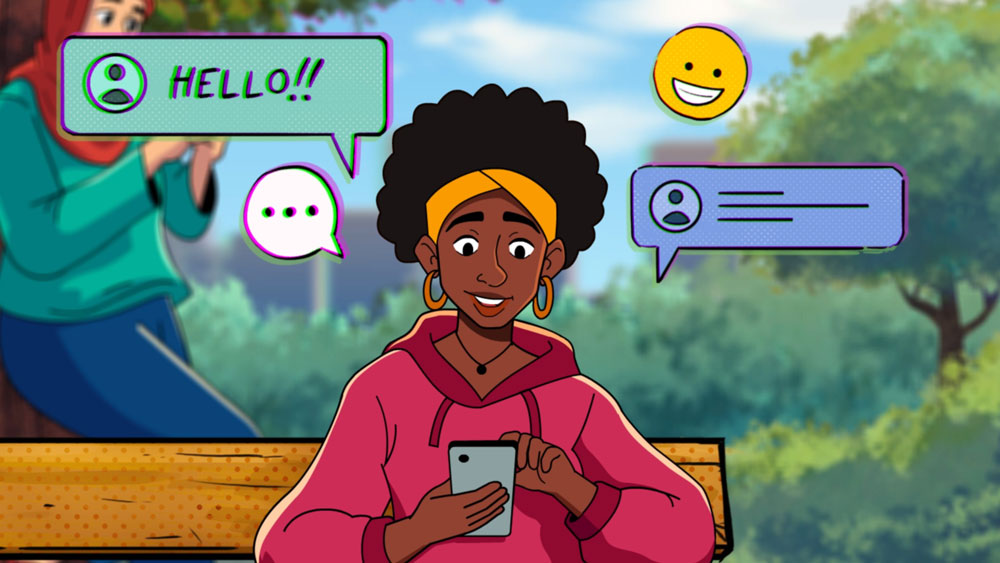
Client: YWCA Canada.
Project type: 2D animated awareness video, 1:31.
Communication challenge: Help young people recognize online hate, including harassment meant to insult, mock or bully, without scaring them away from the internet.
Creative approach: The script opens by admitting that digital life is both exciting and nerve-wracking. Then it names the forms online hate can take in plain language.
The key line is “Everyone is vulnerable, and you are not alone.” It comes before the research on who is targeted most. The goal the script sets is simple. Be aware of the possible dangers and be prepared to respond. It closes on the idea that the internet can be safe and joyful, a place for connection.
Animation let us show online harm without putting a real young person on screen. That matters for an audience that may have lived through it.

I Am A Witness is a bullying prevention campaign from the Ad Council, created pro bono by Goodby Silverstein & Partners. In this video, YouTube creator Ricky Dillon and other creators introduce the Witness emoji.
The idea is aimed at the bystander. The Ad Council says nearly 90% of teens aged 12 to 17 have seen others be mean or cruel on social networks, but fewer than 20% step in. The emoji gives those witnesses a small way to show support. Apple, Facebook, Google and Twitter were among the partners. The Witness emoji was the first anti-bullying emoji adopted by Unicode.
The ask takes one tap. A teen who wants to help but worries about being targeted next has an easy first step.
By the numbers: The Ad Council reported that more than one in three US teens knew about the Witness emoji. The share of teens who felt they could make a difference against bullying rose from 43% before the launch to 56% after it.
KB’s First Day is the first animated webisode in the StopBullying.gov series from HRSA, an agency of the US Department of Health and Human Services. Being the new girl at school is hard for KB. She gets lost, arrives late for class and is called names by other students.
The story starts with a moment most kids know: the first day somewhere new. Viewers see the name-calling through KB’s eyes. The hurt is easy to understand, and nothing on screen is graphic.
StopBullying.gov is the federal site managed by HHS. Its content comes from HHS agencies, the Department of Education and the Department of Justice, so the webisodes sit next to guidance for parents and schools.
By the numbers: HRSA’s upload has more than 540,000 views on YouTube.
Lift Each Other Up is a 15-second Pink Shirt Day spot from CKNW Kids’ Fund. The 2022 campaign asked people to celebrate diversity while raising money for inclusive anti-bullying programs for kids.
Pink Shirt Day grew out of a 2007 protest in Nova Scotia. A group of high school students wore pink in support of a Grade 9 boy who was being bullied. CKNW Kids’ Fund, with Boys and Girls Clubs and 980 CKNW, turned that gesture into an annual movement and fundraiser.
A pink shirt is a visible symbol that anyone can wear. It lets a whole school or office take a stand on the same day. The spot only has to remind people of the date and the cause.
By the numbers: Pink Shirt Day says it has distributed over $3 million in net proceeds to anti-bullying programs in British Columbia and Western Canada. In 2022, the programs it supported reached more than 50,000 children and youth.
Include Someone is an animated video from Cartoon Network’s Stop Bullying: Speak Up campaign, made with PACER’s National Bullying Prevention Center. Cartoon Network characters work together to include new friends.
Stop Bullying: Speak Up launched in 2010. The Include Someone initiative followed in 2019. PACER describes the goal as creating more inclusive communities “to stop bullying before it starts.” Its free classroom kits pair the animated episodes with tip sheets, posters and stickers for elementary students.
Characters that children already know carry the message. The video feels like part of the channel, not a lecture. It also shows the positive behaviour instead of the bullying itself.
By the numbers: The official upload has more than 238,000 views.
#DefyTheName is an anti-bullying PSA led by Monica Lewinsky and created pro bono by BBDO New York. It launched in October 2018 for Anti-Bullying Month.
Well-known people share the names they were called as kids. They include Questlove, Alan Cumming, Andy Cohen, John Oliver, Kelly Ripa and Tony Hawk. The campaign’s stated aim was to use social media to take the power out of those names.
Seeing accomplished adults face their old insults tells young viewers that a name does not decide who they become. The video also points anyone having a hard time to Crisis Text Line.
By the numbers: Twelve organizations backed the launch, including Crisis Text Line, The Diana Award and Ditch the Label.
Teasing vs Bullying is an animated educational video from PREVNet, a Canadian not-for-profit network dedicated to preventing youth interpersonal violence. It answers a question educators often ask. How can I tell if what I’m seeing is bullying or just teasing?
The video separates positive teasing from negative teasing and explains where teasing becomes bullying. It links to PREVNet’s free online training for educators on identity-based bullying. PREVNet was co-founded in 2002 by Dr. Deb Pepler of York University and Dr. Wendy Craig of Queen’s University.
It is built for the adult in the room. A teacher who can name the difference can step in sooner and more fairly. The simple animated figures keep attention on the idea, not on any one child.
By the numbers: PREVNet’s network includes 130 researchers from 30 academic institutions and more than 60 national youth-serving organizations.
This 30-second cyberbullying PSA comes from the Government of British Columbia’s ERASE Bullying strategy. Its message is direct: “When a child shares hurtful comments online, that’s bullying.”
ERASE stands for Expect Respect And a Safe Education. Premier Christy Clark launched it in October 2012 as a 10-point strategy that included an anonymous reporting tool for students. The PSA followed in early 2013 and sent parents to the ERASE website for tips.
The spot speaks to parents and defines one online behaviour as bullying in a single sentence. That gives families a clear standard to talk about at home.
By the numbers: The Government of BC’s upload has more than 520,000 views.
Definition of Bullying is a short animation from the UK’s Anti-Bullying Alliance, which runs Anti-Bullying Week. It explains the Alliance’s definition: “the repetitive, intentional hurting of one person or group by another person or group, where the relationship involves an imbalance of power.”
Bullying can be physical, verbal or psychological. It can happen face to face or online. The Alliance’s guidance breaks the definition into four elements: hurtful behaviour, repetition, power imbalance and intent.
Schools need a shared definition before they can act on a report. The animation gives students and staff the same starting point in about two minutes.
By the numbers: The subtitled version has more than 21,000 views. Anti-Bullying Week 2026 runs November 16 to 20 with the theme Break the Silence.
To This Day is a spoken-word poem about bullying by poet Shane Koyczan. This is his live TED2013 performance, with violin by Hannah Epperson.
The poem first spread as an animated video made crowd-source style by 80 animators. On the TED stage, Koyczan performs it live and tells the story behind it.
The poem speaks from lived experience to anyone who has been called a name. TED describes it as by turns hilarious and haunting. That mix keeps a hard subject watchable for teens and adults.
By the numbers: TED lists the talk at nearly 8 million plays.
Together Against School Bullying is an animation from UNESCO. It follows three young people in different parts of the world who are bullied at school.
The film shows how bullying affects learning, health and well-being. Then it moves to practical actions that everyone can take to help stop it. UNESCO released it in November 2020 for the International Day against Violence and Bullying at School, including Cyberbullying.
Animation lets one 60-second film tell three stories from different countries. It does that without casting real children in painful scenes.
By the numbers: UNESCO’s 2019 global report found that almost one in three students (32%) had been bullied by peers at school at least once in the previous month. The short version of the film has more than 160,000 views.
The videos on this list share five patterns.
The Anti-Bullying Alliance animation, PREVNet’s video and the ERASE PSA all start by naming what counts as bullying. Viewers cannot act on something they cannot recognize.
I Am A Witness and Include Someone speak to the kids who watch, not only the child who is targeted. The bystander is often the person best placed to help.
Tap an emoji. Wear a pink shirt. Invite someone to sit with you. A small, specific ask is easier to act on than a general call to “stop bullying.”
BlockHate, KB’s First Day and Together Against School Bullying use animation to show harm without filming a real child at a hard moment. This is one reason animation is common in nonprofit video production on sensitive subjects.
#DefyTheName names Crisis Text Line. The ERASE PSA sends parents to its website. PACER offers free classroom kits. Every strong video ends with somewhere to go next.
Anti bullying videos are short films that help people recognize bullying and respond to it. Schools use them in lessons and assemblies. Charities and governments use them in public campaigns.
Animated pieces with familiar characters suit younger students. Include Someone from Cartoon Network and KB’s First Day from StopBullying.gov show exclusion and name-calling without graphic scenes. For teens, I Am A Witness and To This Day speak more directly.
An effective video defines bullying, speaks to bystanders, asks for one action and points to help. After I Am A Witness launched, the Ad Council reported that the share of teens who felt they could make a difference rose from 43% to 56%.
Both work. Animation protects the people on screen and suits hard subjects like online hate. Live action works well when a trusted messenger, such as a poet or a well-known adult, tells a real story. Our PSA video examples compare the two formats across other public issues.
Campaign spots on this list run from 15 seconds for Pink Shirt Day to about a minute for UNESCO’s short film. Classroom videos run longer. PREVNet’s Teasing vs Bullying is about seven minutes, and the BlockHate animation we produced for YWCA Canada runs 1:31.

The strongest anti bullying videos do three things. They help viewers recognize bullying. They give bystanders something to do. They show where to find help.
If you are planning one, start with the audience and the single action you want from them. Then choose the format, animation or live action, that shows that action most clearly.

Larry is the Founder and Producer at Mammothic Films, with more than 15 years of production experience. He leads a team that creates story-driven videos for businesses and brands. A marketer, designer, and animator, Larry has overseen the production of more than 1,500 videos for Fujitsu, Logitech, Warner Brothers, NFL, Blockdaemon, Astronomer, Canonical, and 370+ other companies in Canada, the United States, and around the world.
Larry is a devout Christian who believes in placing God first, and that everything else is a blessing that comes from serving Him. When he’s not working, he’s hanging out with his wife and three kids, playing the piano, or sightseeing.
We use cookies to improve your experience on our site.
Manage your cookie preferences below:
Essential cookies enable basic functions and are necessary for the proper function of the website.